The Cold War entered the living room
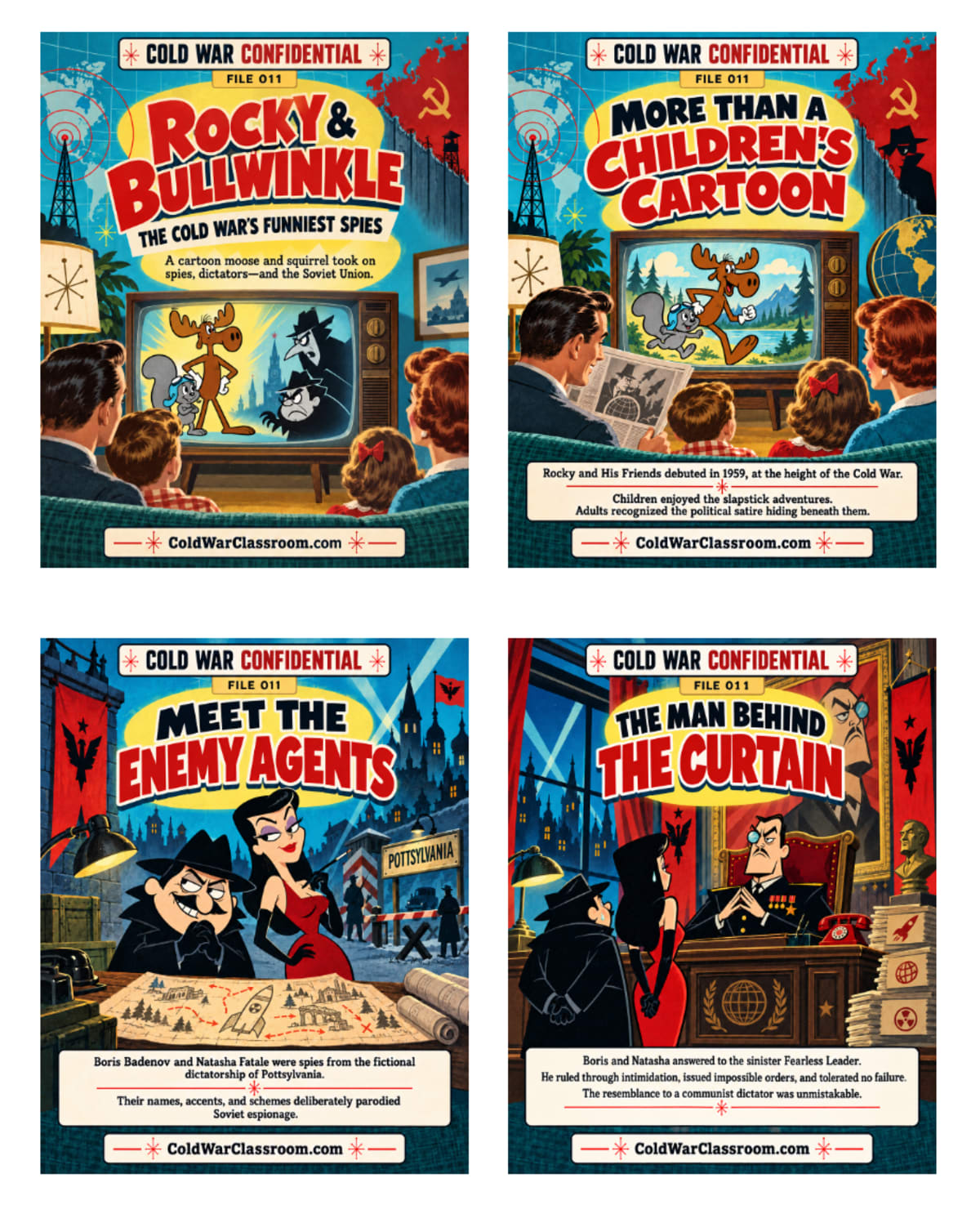
When I watched Rocky and Bullwinkle as a child, I laughed at a dimwitted moose, a clever flying squirrel, and two spies who could never make a plan work. I did not think about ideology, psychological warfare, or the struggle between the United States and the Soviet Union. I simply knew that Boris Badenov and Natasha Fatale came from the wrong side of the Cold War, and Rocky and Bullwinkle stood on ours.
That simple division reveals how deeply the Cold War entered American popular culture. Governments delivered speeches, published magazines, sponsored radio broadcasts, and produced films to win public support. Television carried the contest into American homes, sometimes through news and political advertising and sometimes through comedy. Rocky and Bullwinkle turned Soviet spies, dictators, secret weapons, and international tension into jokes that children could understand and adults could appreciate.
What Cold War propaganda tried to accomplish
Propaganda uses information, ideas, images, or entertainment to influence what people believe, feel, or do. The word often suggests lies, but propaganda does not need to lie. A propagandist can select favorable facts, omit inconvenient details, repeat a slogan, attach an idea to a powerful symbol, or appeal to fear and loyalty. Purpose matters more than truthfulness when historians identify propaganda.
Cold War propaganda supported a larger war of ideas. The United States emphasized individual liberty, democratic government, religious freedom, consumer choice, and material prosperity. The Soviet Union praised collective action, economic equality, anti-imperialism, and communist leadership. Each side highlighted the other side's failures while minimizing its own. Segregation and racial violence damaged American claims about freedom, while censorship, political prisons, shortages, and Soviet control of Eastern Europe weakened communist claims about equality and liberation.
Historians also classify propaganda according to its source. Revealed propaganda identifies the person, government, or organization behind the message. Concealed propaganda hides its sponsor or pretends that someone else created the message. The distinction matters because audiences judge information partly by deciding whether they trust the source. A message that looks independent may persuade people who would reject the same argument from a rival government.
Popular culture joined the conflict
Official agencies did not control every Cold War message. Novelists, filmmakers, advertisers, musicians, and television writers responded to the same fears and assumptions that shaped political debate. Their work could support national ideas without following government orders. A spy thriller might present Soviet agents as ruthless enemies. A science-fiction film might turn communist infiltration into an invasion by aliens who looked human. A television comedy could make the communist world seem threatening, backward, and absurd.
This cultural influence creates an important problem for students. If a government did not sponsor a program, can the program still function as propaganda? The answer depends on how carefully we use the term. Entertainment can reinforce a political message, but political content alone does not prove deliberate propaganda. Historians must examine who created the work, who financed it, what audience it sought, what message it repeated, and whether its creators intended to change beliefs or behavior.
Rocky and Bullwinkle meet the Cold War
Rocky and His Friends debuted in 1959, twelve years after President Harry Truman announced his policy of containing communism and two years after the Soviet Union launched Sputnik. The arms race, the space race, and fear of espionage shaped the national mood. The program's writers drew on that atmosphere while building stories that also mocked advertising, politics, television, and American gullibility.
Boris Badenov and Natasha Fatale gave the show its clearest Cold War connection. The two agents served Fearless Leader, the ruler of Pottsylvania, a fictional dictatorship that borrowed familiar features from the Soviet Union and communist Eastern Europe. Boris and Natasha spoke with exaggerated accents, plotted acts of sabotage, and followed orders from an authoritarian master. Their schemes posed real danger inside the story, but incompetence usually defeated them before Rocky or Bullwinkle did.
The writers used caricature rather than realism. Pottsylvania offered a comic version of the closed communist state: bleak, secretive, suspicious, and crowded with spies. Fearless Leader embodied the dictator and the personality cult. Boris and Natasha represented the hidden agents whom Americans feared during espionage trials, security investigations, and public arguments about communist subversion. Young viewers did not need a lesson on Soviet government to recognize the villains.
Humor made the enemy less frightening
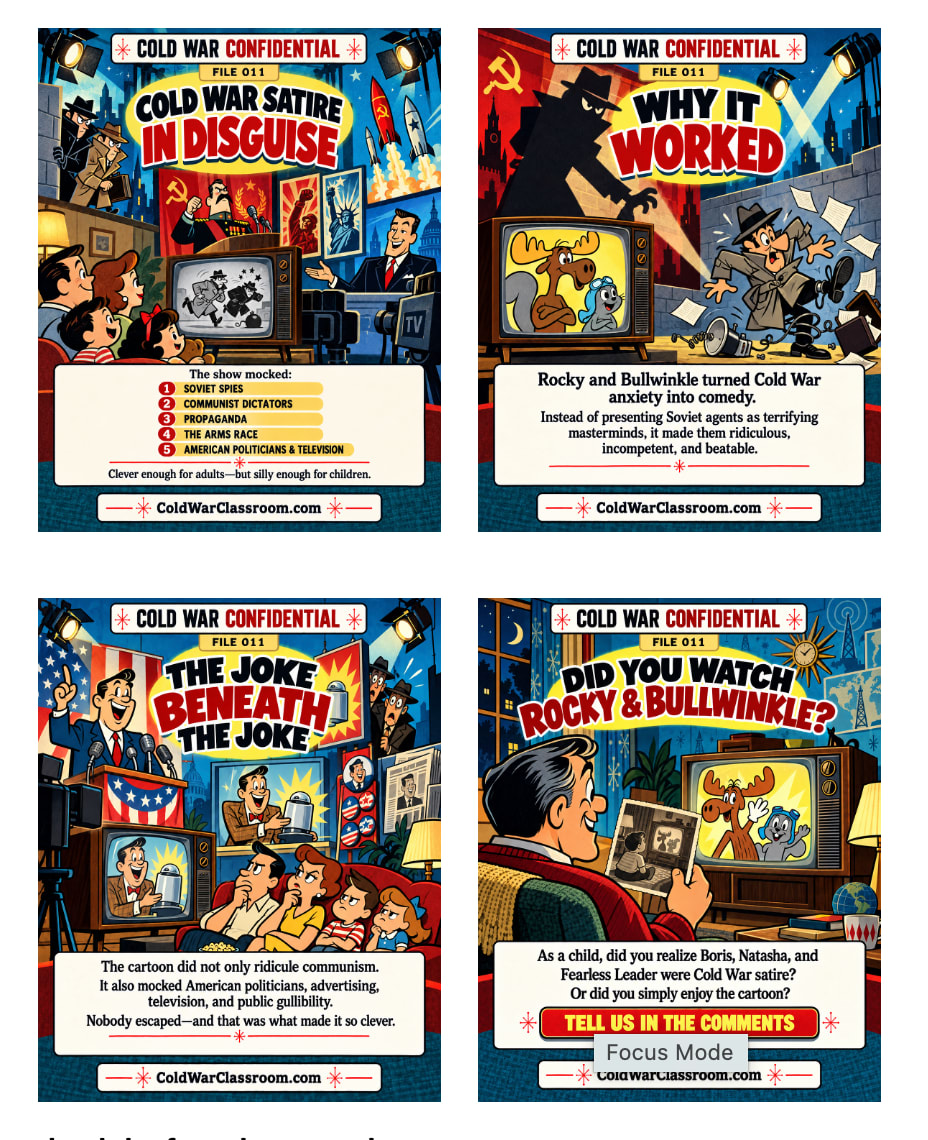
Comedy gave viewers a safe way to approach unsettling subjects. Soviet missiles and nuclear weapons could destroy cities, while Soviet spies had penetrated Western governments. Rocky and Bullwinkle reduced those dangers to plots involving ridiculous inventions, terrible disguises, and villains who regularly sabotaged themselves. Laughter weakened the villains' power without denying that they meant harm.
The show also encouraged a sense of American confidence. Boris and Natasha schemed; Rocky remained alert. Fearless Leader issued commands; Bullwinkle stumbled toward the right result. Pottsylvania relied on secrecy and fear, while the heroes relied on loyalty, persistence, and luck. The contrast matched a familiar American Cold War story in which open society ultimately defeated dictatorship, even when Americans appeared disorganized or foolish along the way.
Yet the satire did not spare the United States. The writers mocked politicians, bureaucrats, celebrities, television conventions, and citizens who believed foolish claims. That wider target matters. A program that ridiculed only the communist enemy would look more like straightforward political persuasion. Rocky and Bullwinkle aimed its jokes in several directions, which makes the program more complicated and more useful as a classroom source.
Did the cartoon count as propaganda
Rocky and Bullwinkle did not originate as an official government campaign, and its creators produced commercial entertainment rather than a classroom civics film. Calling every patriotic story or anti-communist joke propaganda would drain the term of meaning. The program reflected the political culture around it and sold that culture back to viewers through satire.
At the same time, the cartoon reinforced ideas that supported the American side of the Cold War. It linked communist states with dictatorship, secrecy, espionage, and failure. It made the adversary easy to identify and easy to ridicule. Those messages could influence viewers even without a government sponsor or a direct command to support a policy.
The best answer therefore requires evidence and a clear definition. Students may classify the program as entertainment with political content, satire that carried a persuasive message, or cultural propaganda that operated outside official channels. Each conclusion can work if the student explains the purpose, source, audience, techniques, and likely effect. The exercise matters because it teaches students to analyze persuasion instead of merely attaching a label.
A useful lesson for the present
Cold War propaganda reached audiences through posters, films, newspapers, radio, schools, exhibitions, and television. Today's messages travel faster, but they still use familiar methods. They appeal to fear, anger, pride, group loyalty, and distrust. They select facts, repeat claims, create villains, and borrow credibility from sources that audiences already trust.
Students need more than a list of propaganda techniques. They need the habit of asking who created a message, who benefits from it, what emotion it seeks, what evidence it supplies, and what context it leaves out. They also need to distinguish a known source from a hidden or falsely identified one. Rocky and Bullwinkle offer a friendly starting point because humor invites students into the subject before the lesson asks them to make a serious historical judgment.
Download the free classroom lesson
Cold War Classroom offers a free PDF lesson, Cold War Propaganda and Popular Culture A Rocky and Bullwinkle Case Study, for grades 8 through 12. The lesson includes key definitions, a short reading, source-analysis questions, a constructed response, and an exit ticket that asks students to decide whether the source of a propaganda example stands revealed or concealed.
Teachers and homeschool families can download the lesson through BookFunnel and use it during a Cold War, media literacy, or propaganda unit. The activity asks students to support their conclusions with evidence, including the possibility that reasonable students may disagree about whether the cartoon itself qualifies as propaganda.
Sources and Further Reading
National Museum of American History. Animation cel of Boris Badenov, Natasha Fatale, and Fearless Leader from The Rocky and Bullwinkle Show. https://americanhistory.si.edu/collections/object/nmah_1289221
Smithsonian Magazine. How Bullwinkle Taught Kids Sophisticated Political Satire. September 7, 2017. https://www.smithsonianmag.com/innovation/how-bullwinkle-taught-kids-sophisticated-political-satire-180964803/
University of North Carolina. The Rocky and Bullwinkle Show 1959 to 1964. May 9, 2019. https://coldwar.unc.edu/2019/05/the-rocky-and-bullwinkle-show-1959-1964/